
Where wage law and DCAA accounting split
If you run payroll or HR for a company that holds federal contracts, you already answer to more wage rules than most of your peers in the commercial world. You track the Fair Labor Standards Act. You watch state minimum wage and exempt salary thresholds that reset every January. If you have service work or construction work on federal sites, you layer prevailing wage determinations on top of all of it. Getting people paid correctly across those rules is a real job, and you are good at it.
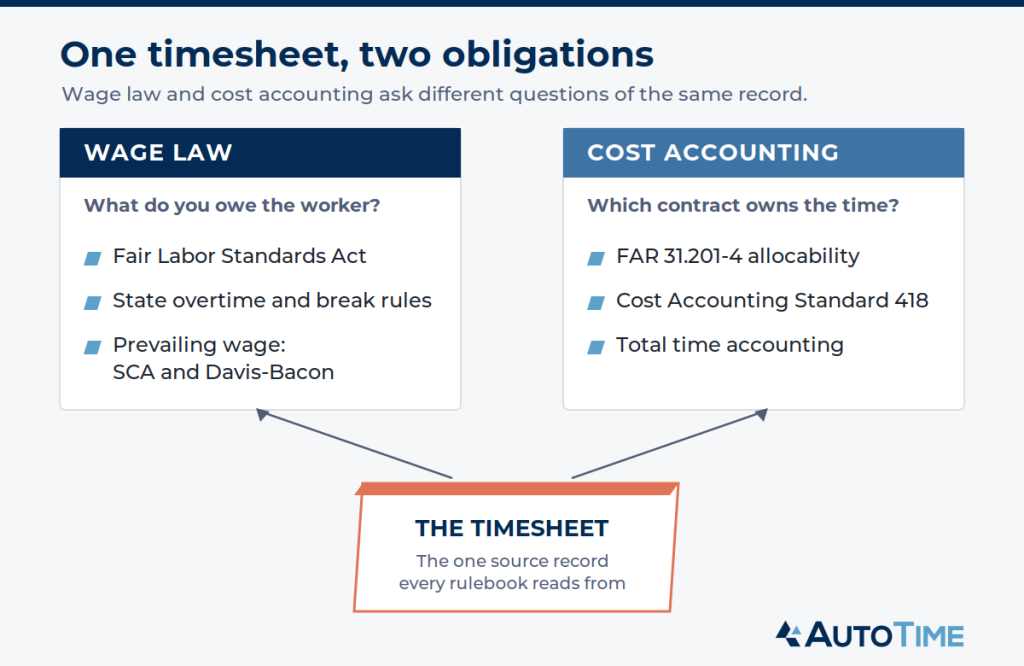
So what catches strong payroll teams off guard? Paying someone correctly is only half of what a federal contractor has to do with an hour of work. The other half happens downstream, in cost accounting, and it answers a different question entirely. Wage law asks what you owe the worker. Cost accounting asks which contract that worker’s time belongs to. Those are two separate obligations, and they both run on the same piece of paper: the timesheet.
You can satisfy one and fail the other without noticing. That is where audit findings come into play.
The wage side keeps moving
The last year and a half has been unusually noisy on the pay side, which makes the split easy to lose track of.
The federal salary threshold for the white-collar overtime exemptions bounced. The Department of Labor’s 2024 rule that would have raised it was struck down in court in November 2024, and in May 2026 the Department formally rolled the regulation back to the 2019 level of $684 per week, about $35,568 a year. So the federal line between an exempt salaried employee and an overtime-eligible one sits where it did in 2019.
The federal contractor minimum wage moved too. Executive Order 14026, the order that pushed the contractor floor past $17 an hour, was revoked in March 2025. The Department of Labor stopped enforcing it and the rule behind it, though that rule technically remains on the books while the agency works through rescinding it. A narrower, older order still reaches some legacy contracts. Meanwhile your contract clauses may still reference the revoked order until a contracting officer modifies them, so what actually binds you can depend on the specific award.
State law did not wait for any of this. California’s statewide minimum wage rose to $16.90 an hour on January 1, 2026. Because California ties its exempt salary floor to twice the state minimum, the California exempt threshold is now $70,304 a year. The same salaried engineer can clear the federal exemption at $35,568 and fall well under the California one at $70,304, which means one person can be exempt under federal law and owed overtime under state law at the same time. Around 40 California cities and counties set their own higher minimums on top of that, keyed to where the employee physically works rather than where your office sits.
These are examples of typical problems for multi-state contractors. The point is that the pay rules are a moving target, and the instinct is to treat compliance as a payroll problem that ends when the paycheck is right.
The cost side has not moved at all
While all of that shifted, the thing that trips up federal contractors in a DCAA audit stayed exactly where it was.
The Defense Contract Audit Agency does not enforce wage and hour law, it makes sure the government pays its fair share of a contractor’s labor and no more. To do that, the DCAA expects you to record every hour worked and distribute those hours across the contracts and cost objectives people actually worked on. The term for it is total time accounting, and it applies to salaried exempt staff too.
Picture a salaried engineer who works 55 hours in a week. She is exempt, so paying her a flat 40-hour salary is fine under the FLSA. But if her timesheet also shows 40 hours when she worked 55, her labor now spreads across her projects as if those extra 15 hours never happened. Every contract she touched carries a distorted share of her cost, and the labor rates built on top of that record are wrong. The pay was right, but the labor cost distribution is not.
DCAA leans on established cost principles here, chiefly the allocability rule in FAR 31.201-4 and, for covered contractors, Cost Accounting Standard 418. The audit manual is blunt about the consequence. When the government is materially overcharged because a contractor failed to record all time worked, the contractor can be cited for noncompliance. Solicitations above the simplified acquisition threshold also carry FAR 52.237-10, which requires you to disclose how you handle uncompensated overtime in the first place.
Prevailing wage work adds its own paperwork on the same foundation. Service Contract Act and Davis-Bacon jobs require you to pay determined wages and fringe rates by labor classification and to certify payroll against them. Get the classification or the hours wrong and the exposure is not a rounding error. It runs to back wages, withheld contract payments, and debarment from federal work for up to three years.
The timesheet is the only thing they all agree on
Step back and the pattern is clear. Wage law, prevailing wage rules, and DCAA cost accounting cover different ground. They set different floors, use different classifications, and answer to different agencies. The one thing they share is the source record. Every one of them reads from the timesheet.
That is the good news, because it means you are not managing five compliance problems. You are managing one record well enough to serve five readers. A time record that captures all hours worked, ties each hour to the right charge code, holds a clean trail when something is corrected, and carries a supervisor’s certification will answer the payroll question and the cost question at once. A record that captures only paid hours, or lets people book time to codes they were never authorized to touch, fails quietly in ways nobody sees until an auditor is sitting across the table.
For an HR or payroll leader, the shift is small but it matters. Stop thinking of the timesheet as a pay input. Start thinking of it as the shared evidence that both your paychecks and your company’s contract billings are honest.
Where this leaves you
You cannot make the wage rules stop changing. You can make the record underneath them dependable.
That means capturing total time for everyone, exempt staff included. It means controlling which charge codes each person can even see, so time lands where the work happened. It means keeping corrections transparent, with a record of what changed and who approved it. Build those habits into the system that collects the hours, and the downstream readers all draw from the same trustworthy source.
That is the reason AutoTime exists. It is built for government contractors to capture accurate, total-time labor records, enforce charge-code visibility by contract and task, and keep an auditable trail through every correction, then hand that clean record to the payroll and accounting systems that depend on it. It does not classify your employees or interpret which wage rules apply. It makes sure your payroll, finance, and compliance teams are working from a record that holds up.