
Labor records continue to be a priority.
DCAA’s FY2025 Report to Congress shows that contracting officers upheld 42.6% of the costs DCAA questioned in incurred cost audits, up from 31.4% the year before. The report also describes the data systems DCAA is building to expand its use of artificial intelligence. Incurred cost submissions are built on labor hours and on indirect rates calculated from those hours, so the accuracy of each submission depends on the timekeeping record behind it.
What did DCAA report for FY2025?
DCAA submits a report to Congress each year under 10 U.S.C. §3847. In the FY2025 report, the agency reported 2,480 audit reports and 7,047 memos covering $788 billion in contract costs. Auditors identified $18.8 billion in audit exceptions, and DCAA reported $5.3 billion in savings across the roughly 9,000 contractors it oversees.
Incurred cost audits remain a priority because they are required by law. DCAA issued 536 incurred cost audit reports on high-risk submissions and 2,831 memos on lower-risk submissions that received streamlined reviews. The report also states that contractors removed more than $3.8 billion in unallowable costs from their submissions before audits began. Contractors that review their own records before filing, and that keep audit-ready timekeeping throughout the year, enter the process with fewer open questions.
What does the sustention rate measure?
When DCAA questions a cost, the finding goes to the contracting officer, who decides whether to uphold it. The share of questioned costs that the contracting officer upholds is called the sustention rate. DCAA describes it as a key measure of the agency’s effectiveness.
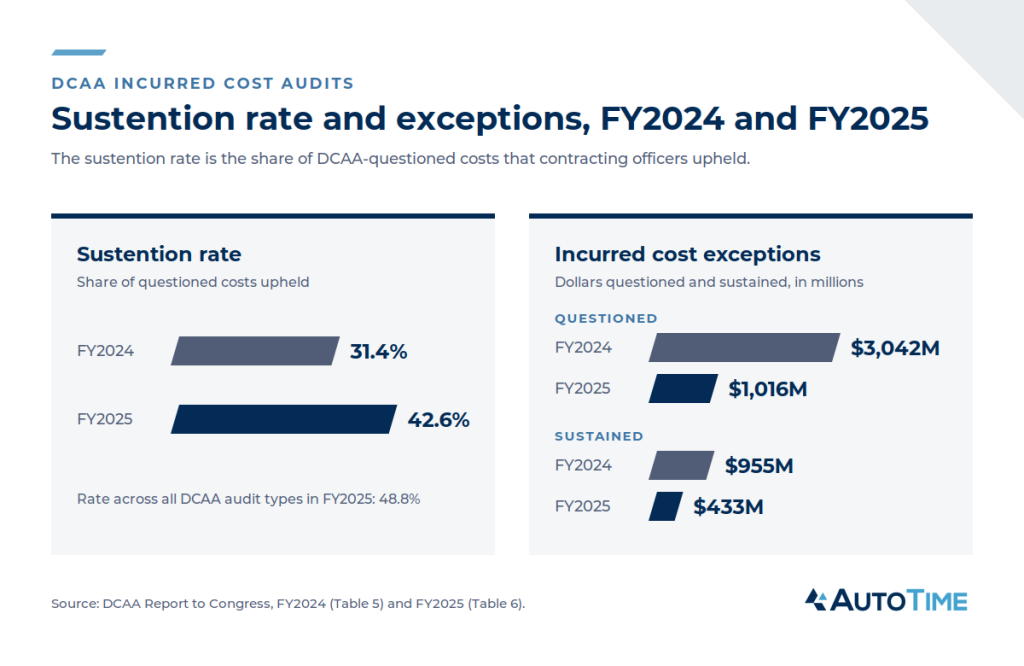
For incurred cost audits, the sustention rate rose from 31.4% in FY2024 to 42.6% in FY2025. In FY2025, contracting officers sustained $433.3 million of $1.02 billion in incurred cost exceptions. Forward pricing audits were sustained at 45.8%, and the rate across all audit types was 48.8%.
The dollar amounts moved in the other direction. The FY2024 report showed $3.04 billion in incurred cost exceptions, compared with $1.02 billion in FY2025. The sustention rate measures the share of questioned costs that hold up, which is separate from the total amount DCAA questions. Sustained amounts also tend to come from audit reports issued in earlier years, because contracting officer actions can take years to finalize. For contractors, the rate means a questioned incurred cost is more likely to stand than it was a year earlier. Contractors with a prior finding face a related test, since DCAA’s follow-up audit programs check whether corrective actions held.
Where do labor records fit in an incurred cost audit?
An incurred cost submission is the annual proposal a contractor files to establish final indirect cost rates on flexibly priced contracts. Direct labor costs appear throughout its schedules, and labor is a common base for allocating overhead.
Labor data passes through several records before it reaches the submission. Employees record hours to charge codes, and supervisors approve the timesheets. The labor distribution system assigns those hours and costs to contracts and indirect accounts, and the general ledger accumulates the totals. The criteria for an acceptable accounting system in DFARS 252.242-7006 include a timekeeping system that identifies labor by intermediate or final cost objectives and a labor distribution system that charges direct and indirect labor to the appropriate cost objectives.
Recorded hours need to include all hours worked. When a salaried employee works 50 hours and records 40, the cost per recorded hour is overstated, and the error carries into the rates charged to contracts. We covered this in more detail in our post on wage law and DCAA cost accounting.
DCAA’s report lists real time labor and material reviews among its activities during contract performance, alongside incurred cost audits and business system compliance reviews. Each of these reviews reads from the same labor data. The same records also carry weight in enforcement, which we covered in our post on timekeeping and the False Claims Act.
How does data analytics change what DCAA can see?
The report describes several data projects. DCAA is rebuilding its data warehouse into a data lakehouse, has expanded into enterprise data in the War Data Platform, and now collects provisional billing submissions through its contractor submission portal. DCAA states that these projects provide the foundation to expand its use of AI, and it reports using AI and large language models in targeted contract reviews.
The report does not describe how DCAA applies these tools to labor data. The practical effect for contractors is that information submitted at different times becomes easier to compare. Provisional billing rates, incurred cost submissions, and records produced during an audit all trace back to the same timekeeping data. In a review of the report, CohnReznick noted that weak systems and unexplained variances become easier for auditors to identify.
What does the reorganization change?
In FY2025, DCAA replaced its legacy regions with Land, Sea, and Air directorates that are embedded with the military buying commands they support. It also established a Centralized Audit Function for complex, high-risk audits. Auditors aligned with a buying command are likely to know its programs well, and program knowledge helps an auditor judge whether labor charges match the work being performed.
What can contractors do now?
- Reconcile on a schedule. Compare timekeeping hours to labor distribution, payroll, and the general ledger each month so differences are found and explained before a submission is filed.
- Review corrections made after approval. Confirm that each change to an approved timesheet records the original entry, the reason, and the approver.
- Confirm total time accounting in practice. Check that salaried employees record all hours worked, including hours above 40, as the written policy requires.
- Tie labor schedules to source records before filing. Trace the labor figures in the incurred cost submission back to the labor distribution reports that support them.
- Confirm the cognizant DCAA office. Identify which directorate and office now cover your contracts under the new structure.
How AutoTime supports audit-ready labor records
AutoTime is a DCAA-compliant timekeeping and labor-tracking platform built for aerospace and defense contractors. It enforces daily time entry and supervisor certification, captures total time for salaried and hourly employees, limits employees to the charge codes they are authorized to use, and keeps an audit trail of every correction with the original entry, the reason, and the approver. AutoTime integrates with ERP systems including Deltek Costpoint, Oracle, SAP, and JAMIS Prime, so the labor record that supports each timesheet is the same record that supports the incurred cost submission.
To see where your current process stands, take the DCAA Timekeeping Compliance Assessment. It takes about three minutes and scores readiness across six areas.