
Fixed-Price Is Now the Default. Here’s What the FAR Part 16 Update Means for A&D Contractors.
A rule change that took effect July 15 makes fixed-price the government’s preferred contract type and puts a paperwork gate in front of almost everything else. What changed, and why your labor data suddenly carries more weight than it did last month.
On July 15, 2026, the federal government stopped treating fixed-price contracts as one choice among several and started treating them as the answer it expects. The FAR Council’s updated deviation text for FAR Part 16, “Types of Contracts,” now names fixed-price the “default and preferred contract type.” Cost-reimbursement, time-and-materials, firm-fixed-price level-of-effort – anything that isn’t fixed-price – now needs a written justification and a signature from the agency head before it can be used on a larger award.
For aerospace and defense manufacturers, that lands harder than a line edit to a rulebook. It changes who carries the cost risk on your next contract, and it raises the penalty for getting your labor numbers wrong.
What actually changed
On July 1, the FAR Council issued a deviation revising Part 16 to implement Executive Order 14402, “Promoting Efficiency, Accountability, and Performance in Federal Contracting,” which President Trump signed April 30. The text posted July 1 and took effect July 15.
Revised FAR 16.102 now states plainly that fixed-price is the default and preferred type. Agencies are also told to consider fixed pricing for portions of a requirement even when the whole contract can’t be structured that way. The practical read: expect contracting officers to start carving requirements into separately priced deliverables to push as much work as possible onto fixed-price terms.
The change is one piece of the broader Revolutionary FAR Overhaul, the phased rewrite of the entire acquisition rulebook launched under Executive Order 14275 in April 2025. The FAR is being revised part by part, and each new deviation gets tracked on the government’s FAR Part Deviation Guidance page. The Part 16 and companion Part 52 updates have their own guidance entry on acquisition.gov.
The new approval gate
The update creates a category called “covered contracts or orders” – anything that is other than fixed-price, firm-fixed-price level-of-effort, or a hybrid that contains one of those elements. Once a covered contract crosses its agency dollar threshold, the contracting officer has to prepare a written justification and get it approved by the agency head. That approval can be delegated only to the chief acquisition officer or a non-career Senior Executive Service official. No lower-level sign-off will do.
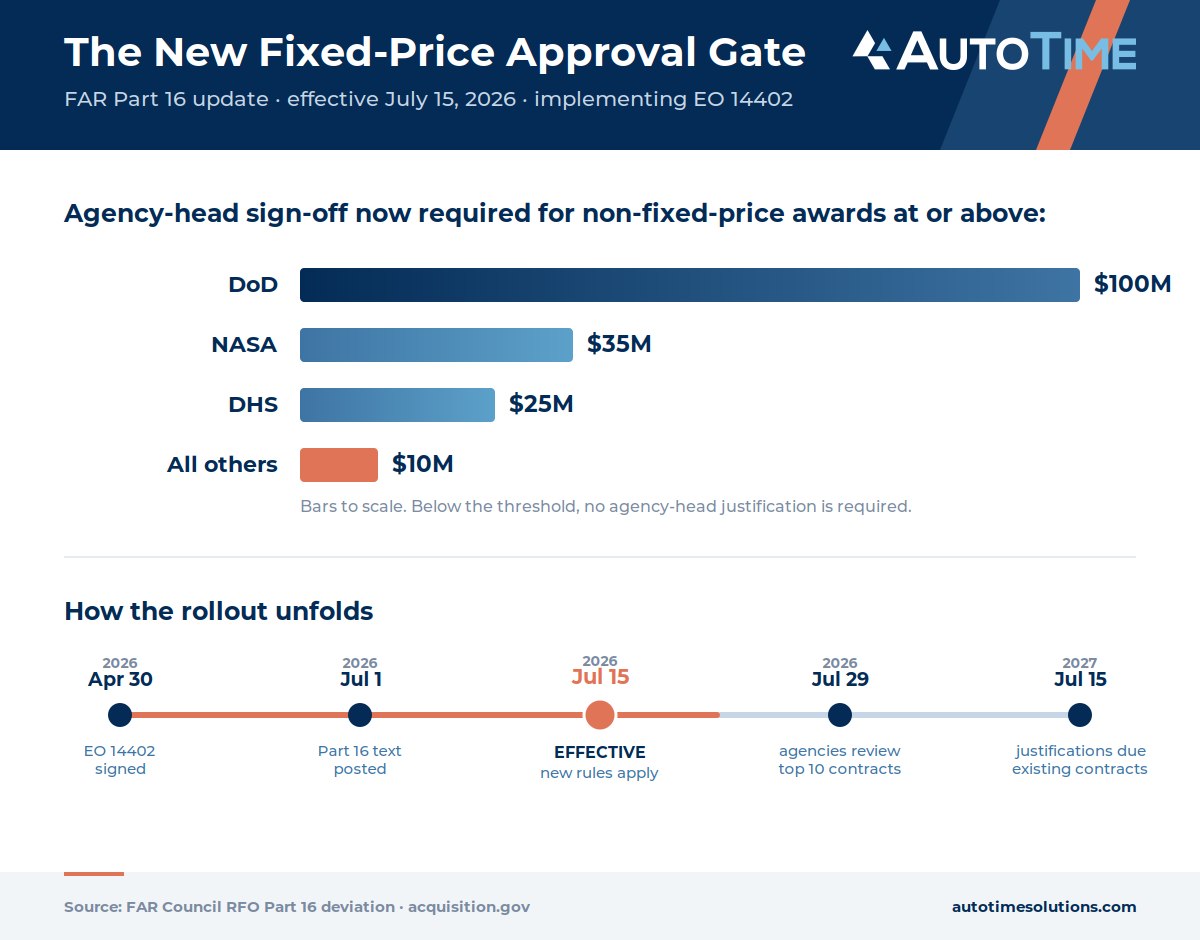
The approval thresholds sit at or above:
- $100 million for the Department of Defense
- $35 million for NASA
- $25 million for the Department of Homeland Security
- $10 million for all remaining federal agencies
A few things sit outside the gate. Multiple-award contracts themselves are excluded, though task orders, delivery orders, and Blanket Purchase Agreements issued under them can still be covered. Emergency, disaster, and contingency work is out, as are research and development contracts and pre-production development for major systems. And fixed-price incentive or award-fee contracts don’t count as “covered” when the incentive or fee rides solely on performance rather than cost. Expect those performance-based structures to become a lot more common.
The dates that matter
For new solicitations, the required justification has to be approved before release, starting July 15. For solicitations that went out before July 15 but haven’t produced an award, and for existing contracts or orders with at least 18 months of performance left as of July 15, the justifications should be issued no later than July 15, 2027.
There’s a separate clock running too. EO 14402 tells each agency head to review the agency’s 10 largest non-fixed-price contracts by dollar value within 90 days and, where practical, restructure or renegotiate them toward fixed pricing. Because the order dropped April 30, that review window closes July 29. If you hold a large cost-type contract, don’t be surprised to hear from your contracting officer about it.
Why a contract-type rule lands on the shop floor and in finance
Here’s the part that doesn’t show up in the legal summaries. A shift toward fixed-price is a shift of cost risk onto the contractor. On a cost-reimbursement contract, the government pays your allowable costs; if labor runs long, they largely absorb it. On fixed-price, you quoted a number and you own the outcome. Every hour you underestimated comes straight out of your margin.
That makes two things far more valuable than they were in June: pricing the bid correctly up front, and controlling labor to plan during performance.
Pricing correctly depends on knowing your true, fully burdened labor cost by task and by work order – and that only comes from clean historical labor data. If your time records are approximate, your fixed-price bid is a guess, and it’s now a guess you’re contractually locked into. The update also narrowed economic price adjustments under revised FAR 16.203-3, so there are fewer chances to adjust price for labor or material swings after the fact. Less room to recover means your inputs have to be right the first time.
Cost-type work hasn’t disappeared, either. It got watched more closely. The revised rules require a designated contracting officer’s representative to monitor performance and cost controls on cost-reimbursement contracts. So on the cost-type and T&M work that still clears the approval gate, your labor system needs to hold up under a sharper look. And through all of it, DCAA hasn’t left the building – labor is still the largest and most scrutinized cost on any federal contract, and timekeeping adequacy is still what an accounting-system audit turns on.
This is where a purpose-built labor system earns its keep. Capturing every hour to the second against the right cost objective, enforcing Total Time Accounting so timesheets can’t close until every hour is allocated, and building a defensible history of what work actually cost on the floor – that’s the raw material for both a competitive fixed-price bid and a margin you get to keep.
What to do now
- Assume more of your pipeline prices fixed. Re-look at opportunities you’d penciled in as cost-type and re-check the math on each one.
- Pressure-test your estimating inputs. Pull actual labor cost by task and work order for comparable past jobs. If you can’t produce it cleanly, that gap is the first thing to close.
- Control labor during performance, not after. On fixed-price, an overrun you catch in month nine is margin already spent.
- Keep your cost-type house in order. The contracts that survive the new approval gate will be the ones under the microscope.
- Watch the deviations. Part 16 is one part of a rolling rewrite; agencies adopt on their own timelines and Phase II rulemaking is already underway.
The bottom line
The overhaul’s stated goal is cost predictability for the government. Read the fine print and a chunk of that unpredictability moves onto your books. The A&D contractors who come out ahead will be the ones who can price from real numbers and defend every hour – before the contract is signed, and long after the auditor shows up. If your labor data can’t do both today, that’s the project worth starting this quarter.
AutoTime Solutions builds DCAA-compliant timekeeping and labor tracking purpose-built for aerospace and defense government contractors. See how the platform works.