A summary of the CMMC Reform Task Force’s findings, obtained and reported by Federal News Network in late October, shows that the costs defense contractors described in their feedback come mostly from implementing and maintaining NIST SP 800-171 security controls rather than from the CMMC assessment itself. The summary also lists reform options, including a restart of Phase 2 within 90 days for a narrower group of contractors.
The Department of War has not adopted any of these options and declined to comment on the reporting. As of November 17, 2026, the task force report has not been published, Phase 2 remains suspended, and the Phase 1 self-assessment requirements remain in force.
For contractors, the practical reading is straightforward. The controls that drive most of the cost are the same controls DFARS 252.204-7012 already requires, and none of the options in the summary removes the 800-171 requirement for companies that handle controlled unclassified information. This article covers where the program stands, what the request for information (RFI) responses showed, which options are under consideration, and what contractors can do while the decision is pending. For background on the July suspension, see our earlier coverage of the CMMC Phase 2 pause.
Where does CMMC stand in November 2026?
November 10, 2026 was the scheduled start of Phase 2, when Level 2 certification by a third-party assessment organization (C3PAO) would have become a condition of award for many contracts involving controlled unclassified information (CUI). On July 13, DoW Chief Information Officer Kirsten Davies suspended that transition along with the later phases and stood up a CMMC Reform Task Force with 60 days to review the program.
On September 3, the Department issued Class Deviation 2026-O0025, Revision 3, signed by John M. Tenaglia, Principal Director of Defense Pricing, Contracting, and Acquisition Policy. The deviation directs contracting officers to remove third-party assessment requirements from solicitations and contracts and to use only CMMC Level 1 (Self) or Level 2 (Self) during the suspension. Its CMMC language carries forward from Revision 2, issued July 16.
The task force’s review closed on September 11, and its findings went to the CIO. Davies has said the report will be released, but no date has been set. The underlying obligations stayed the same. DFARS 252.204-7012 still requires contractors that handle CUI to implement the 110 requirements of NIST SP 800-171 Revision 2, keep a current score in the Supplier Performance Risk System (SPRS), and report cyber incidents to the Department within 72 hours.
What did the RFI responses say about cost?
The Department’s July memo cited prohibitive compliance costs, a shortage of third-party assessment capacity, and complex regulatory timelines as reasons for the pause. Federal News Network’s reporting on the internal summary compares those reasons with the responses the task force received.
The task force reviewed 997 responses to its RFI, and 509 of them came from companies in the defense industrial base. Vendors, consultants, and other members of the CMMC ecosystem submitted the rest. According to the summary, respondents named implementing and maintaining NIST SP 800-171 controls as their top cost driver. That category covers software licensing, secure enclaves, documentation, and fees for managed service and cloud providers.
The summary put the average cost of CMMC compliance, separate from the 800-171 controls, at about $47,000. In July, Small Business Administration Administrator Kelly Loeffler said CMMC compliance could cost as much as $600,000. On capacity, sources told Federal News Network that contractors had used less than half of the available assessment capacity.
Parts of the feedback also support the Department’s position. In September, Davies told an audience at the Billington CyberSecurity Summit that the Department had received more than 1,100 responses and that more than half supported the Phase 2 suspension. That count differs from the 997 responses in the summary, and the Department has not explained the gap. Small businesses did raise cost concerns in large numbers. The summary places most of those costs in the security controls, which remain in effect during a pause on assessments.
What reform options did the task force put forward?
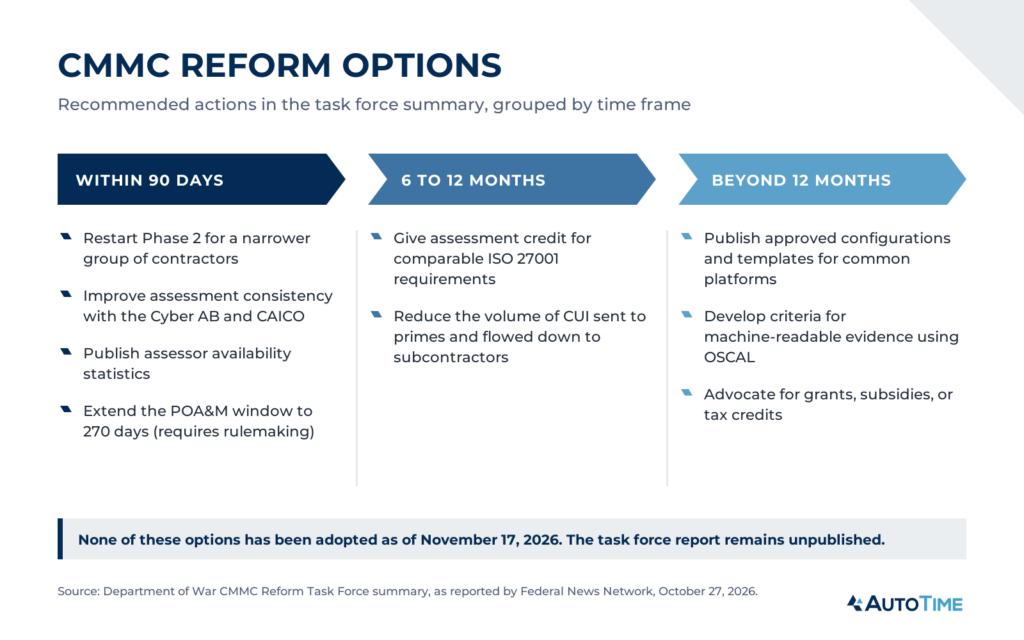
The summary sorts reform ideas into three categories: changes the DoW CIO can make without rulemaking, changes that are more difficult or costly and may require rulemaking, and suggestions outside the CIO’s authority. It then groups recommended actions by time frame, as detailed in the second part of Federal News Network’s investigation.
- Within 90 days. Restart Phase 2 for a narrower population of contractors while longer-term changes move through rulemaking. Work with the Cyber AB and the Cybersecurity Assessor and Instructor Certification Organization (CAICO) to make assessments more consistent, and publish assessor availability statistics. Expand the plan of action and milestones (POA&M) window to 270 days, a change the task force notes would require rulemaking.
- Within 6 to 12 months. Give explicit assessment credit for comparable ISO 27001 requirements. Reduce the volume of CUI the Department sends to prime contractors through training, marking tools, and security classification guides, and help primes do the same with their subcontractors.
- Beyond 12 months. Publish approved configurations and templates for common platforms, similar to security technical implementation guides (STIGs), and develop criteria for machine-readable evidence using OSCAL. Advocate for grants, subsidies, or tax credits. The summary notes the Department could build free tools if funding allows, but it cannot create grants or tax credits on its own.
The summary also recommends finalizing the move to NIST SP 800-171 Revision 3, which DFARS requirements have not yet adopted. A task force recommendation is advisory. Contract requirements change only through a new class deviation, a DFARS rule, or an amendment to 32 CFR Part 170, the CMMC program rule.
Why does CUI marking matter in the reform discussion?
Of all the recommendations, the summary identifies clearer CUI marking as the change with the most potential to reduce the number of companies subject to NIST SP 800-171. Respondents described inconsistent marking by the military services and defense agencies, which leaves contractors unsure which systems they need to secure. A planned Federal Acquisition Regulation rule on CUI would add a standard form that spells out which CUI is shared under each contract.
Until that rule is final, contractors make the scoping decision themselves. Companies that know where CUI enters their environment, which systems store or process it, and which employees and subcontractors handle it are in a better position under any outcome. A narrower, well-documented scope lowers cost and gives an assessor, a prime, or a contracting officer a clear boundary to review.
What should contractors do while the decision is pending?
Several steps hold their value regardless of when or how Phase 2 returns.
- Keep the SPRS score and affirmations current. Phase 1 self-assessments remain a condition of award where a solicitation specifies a CMMC level, and the annual affirmation by a senior company official still applies. Conditional Level 2 status requires a minimum score of 88 out of 110.
- Map how CUI moves through the business. Document where CUI arrives, where it is stored, and where it flows to subcontractors. This work supports the scoping changes the task force recommended and reduces cost under the current rules.
- Plan POA&M work against the current 180-day window. The 270-day extension in the summary would require rulemaking, so it has no effect on assessments today.
- Keep evidence that supports the self-assessment. Eric Crusius, a partner at Hunton, told Federal News Network that NIST SP 800-171 remains a requirement and that contractors still face False Claims Act exposure, contract cancellation, and negative CPARS ratings. A self-assessment score is a representation to the government, and the records behind it determine how well it holds up under review.
- Treat third-party assessment as a business decision. Some prime contractors continue to ask suppliers about CMMC readiness on their own timelines. Crusius also noted that a third-party assessment makes it harder to argue that a company acted recklessly. Contractors with assessments already scheduled can weigh that value against the cost of waiting for the Department’s decision.
Our CMMC certification page covers the Level 1 and Level 2 requirements in more detail.
Keeping records that hold up
The task force summary describes a program in which most of the cost comes from operating security controls every day and keeping the records that show those controls work. The same discipline applies to labor data. DCAA looks for many of the same qualities in timekeeping records that a cybersecurity assessor looks for in an information system: controlled access, a complete audit trail, and entries that trace back to the person who made them.
AutoTime Solutions provides DCAA-compliant timekeeping for aerospace and defense contractors, with role-based access controls, audit logging, and encrypted mobile and remote time entry built on a CMMC-aligned architecture. Contractors who want to review their own timekeeping controls can take the 3-minute DCAA Timekeeping Compliance Assessment.