Idle time is a normal part of production work. Parts arrive late, a machine goes down, or an inspection holds up the next operation. On a government contract, the compliance question is where those hours are recorded. Hours without assigned work belong on an indirect labor account. When they are charged to a contract as productive labor, the contractor bills the government for work that was not performed, and that creates False Claims Act exposure.
A February 2026 settlement shows how this plays out when supervisors tell employees to fill the shift on their timecards.
What happened in the 2026 settlement
In February 2026, a site services contractor for the Department of Energy paid $3.45 million to resolve allegations that it overcharged the government for labor hours. The contractor held a multi-billion-dollar, performance-based prime contract supporting environmental cleanup, and the contract reimbursed its allowable costs, including labor.
According to the allegations announced by the U.S. Attorney’s Office, management knew about and failed to prevent inflated labor hours. Employees were not given enough work to fill a shift and were then directed to record their time as if they had worked the entire shift.
The settlement agreement is narrower and more specific. The contractor admitted that between August 17, 2020, and September 30, 2025, it at times sought and received reimbursement for labor hours that included unallowable excessive idle time, including hours when employees were not scheduled or assigned sufficient work. It did not concede liability under the False Claims Act.
The contractor paid $3.45 million, of which $1,725,000 is restitution. It also agreed to pay $1.49 million for the whistleblower’s attorneys’ fees and costs. The case began with a pipefitter on the contract, who filed a whistleblower complaint under seal in December 2021 and a second complaint in May 2024. That employee will receive $793,500 of the settlement.
This case involved a civilian agency contract. The False Claims Act applies to every federal contract, and labor charging on Department of War contracts is examined the same way.
What counts as idle time on a government contract?
Idle time is paid time when an employee is at work but has no assigned task to perform. Common causes include waiting for materials, waiting for inspection, equipment downtime, and gaps between jobs.
Contractors record idle time as indirect labor. A fraud scenario reference from the Department of War Office of Inspector General describes a contractor with specific indirect labor accounts that direct labor employees charge when they perform indirect functions, with idle time listed alongside training and special projects. The cost flows into an overhead pool and is allocated across the contractor’s work under its disclosed accounting practices, instead of landing on a single contract.
DCAA tests this directly. Its labor floor check audit program directs auditors to determine whether the contractor has established procedures for coding and recording idle time, and auditors analyze idle time by reason, such as waiting for inspection or lack of materials. A contractor with no idle time code, or one whose employees never use it, gives auditors a reason to ask where those hours went.
One shift, two records
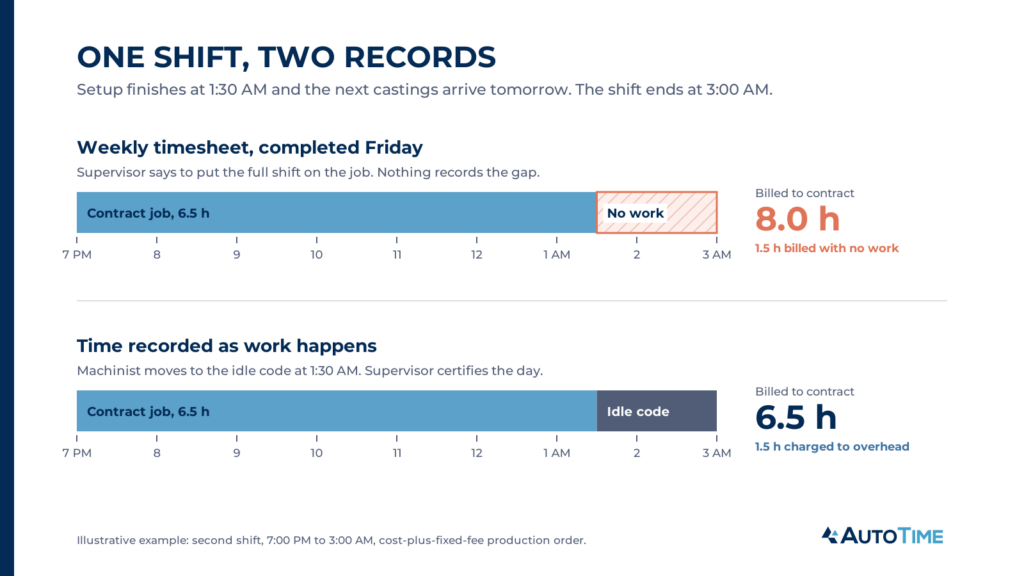
Consider a second-shift machinist at an aerospace parts supplier working on a cost-plus-fixed-fee production order. This example is an illustration and is separate from the case above. The shift runs from 7:00 p.m. to 3:00 a.m. Setup on the job finishes at 1:30 a.m., and the next batch of castings will not arrive until the following day. The supervisor tells the machinist to put the full eight hours on the job.
In the first version, the company uses a weekly timesheet that employees complete on Friday. The machinist enters eight hours against the contract charge code for that night. Nothing on the timesheet shows that work stopped at 1:30 a.m. or that a supervisor made the call. The contract is billed for eight hours of direct labor. If a DCAA auditor interviews the machinist during a floor check, the description of that night will not match the timesheet.
In the second version, the machinist records time as the work happens. At 1:30 a.m. the machinist closes out the contract job and moves to the indirect idle time code, or to another assigned task with its own authorized charge code. The supervisor reviews and certifies the day’s time before it moves to payroll and billing. If the record needs to change later, the correction carries a reason and the name of the person who made it. The contract is billed for six and a half hours of direct labor, and the remaining 90 minutes go to overhead.
The second record gives up 90 minutes of direct billing for that night. The first record creates a claim for 90 minutes of labor that was not performed. Repeated across a crew over several years, the first pattern is what the 2026 settlement describes.
Why the exposure lands on management
The 2026 allegations focused on what management knew. The False Claims Act covers claims a contractor submits knowingly, and the statute’s definition of knowingly includes deliberate ignorance and reckless disregard of whether a claim is accurate. A supervisor’s instruction to fill the shift, timesheets completed days after the work, and a missing review step are the facts investigators examine when they decide whether a company knew.
The employees who receive those instructions are often the ones who report them. The False Claims Act lets an employee file a complaint under seal and share in the recovery, which is how the 2026 case started. The costs continue after a settlement. Under the 2026 agreement, the contractor’s legal fees, investigation costs, and corrective actions tied to the matter are unallowable under FAR 31.205-47 and cannot be charged to any government contract. A written idle time policy, an idle time code employees are expected to use, and supervisor review that leaves a record give the company evidence that its labor charges match the work performed.
What DCAA looks for in labor records
DCAA labor floor checks verify that employees are at work, that they are performing in their assigned job classification, and that their time is charged to the proper cost objective. Auditors interview selected employees, compare their answers to their timecards, and review the procedures behind the records, including how idle time is coded. Correction histories and supervisor approvals show auditors whether time is recorded as work happens or assembled afterward.
For cost-reimbursable and time-and-materials work, the same records support billing and incurred cost submissions. The share of DCAA incurred cost findings sustained rose from 31.4% in FY2024 to 42.6% in FY2025, according to DCAA’s FY2025 Report to Congress. Labor records that show where every hour went, including the hours without assigned work, hold up better under that review.
Recording every hour with AutoTime
AutoTime Solutions supports this labor charging discipline for aerospace and defense contractors. Employees record time as work happens, see only the charge codes authorized for their contract and task, and move to indirect codes when assigned work stops. Supervisors certify daily time, every correction carries a reason and an audit trail, and Total Time Accounting keeps every hour of the shift on the record. To see how your current timekeeping holds up, take the 3-minute DCAA Timekeeping Compliance Assessment.